Consultant or agency
Evidence-based, but slow and expensive6-8 weeks and $4K-64K. It ends as a PDF that ages the moment it is printed
Segmentable builds a model of your market from open data: segments, needs, competitors, and channels. The Segmentable platform turns the collected data into an answer: whom to sell to, what to sell, and through which channels. Every number can be verified through the source database
Leave a request — we will discuss your task and suggest a research format
The situations differ, but the structure is the same: you need market knowledge that does not exist internally yet, and you need to rely on it
You need segments, competitors, channels, and launch materials before the launch budget burns out
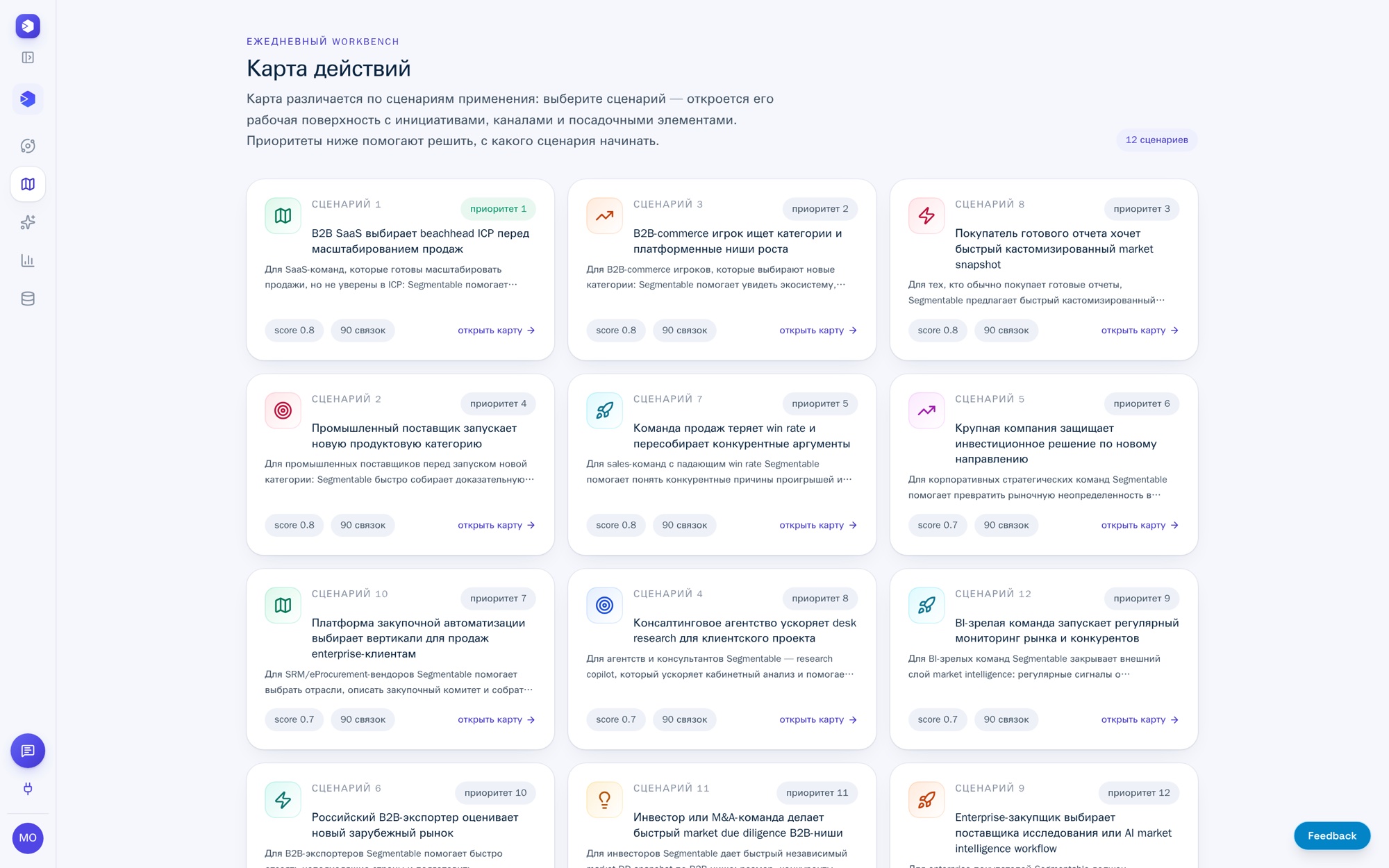
From hypotheses to launch materialsScenario breakdownCAC is rising and auctions are getting expensive, so you need to see the market structure and new entry points
New segments + ICP + channelsScenario breakdownDifferent behavior, different players, different channels — with even less knowledge than at home
Market landscape + entry playsScenario breakdownThe CEO, board, or investor expects arguments, not opinions — every number must withstand review
Source-backed argumentationScenario breakdownLeadership asks to validate by a date, while each check can take a team a quarter
Validation pipeline: days, not quartersScenario breakdownYou know how to build the product, but not how to sell it; you need a grounded path, not a channel lottery
Whom to sell to, what to sell, and whereScenario breakdownDo not see your situation? Describe the task in your own words —
Market knowledge is structurally missing inside the company: expertise is tied to an old segment, the portfolio is wider than any single expertise, and idea flow exceeds team capacity
6-8 weeks and $4K-64K. It ends as a PDF that ages the moment it is printed
The market knowledge gap is structural, not personal: the team has neither the tools nor the time
Essays without sources: you cannot prioritize, verify, or take them to the board
Segmentable combines all three: methodological structure + evidence for every number + a working surface for the team. In hours, not weeks Detailed comparison →
The same discipline as a research team: frame, collection, analysis, strategy, materials. The AI-agent pipeline executes it
Product, market, hypotheses — or simply a link to your website
A pipeline of AI agents gathers open data: competitors, reviews, prices, channels, vacancies. One click to readiness
Connected catalogs from segments to channels. The methodology is consistent, so projects are comparable
TAM, Kano, SWOT-5, benchmarks, forecasts, seasonality. Each one has a key conclusion and click-through to source
Segment × need × channel plays, use cases, action map, presentations, and sales kits
Nothing is taken from your perimeter — a ready argument for security review
Works as a service: no CRM integrations or developer involvement required
Not a PDF in a drawer, but a working system: data stays alive and turns into action
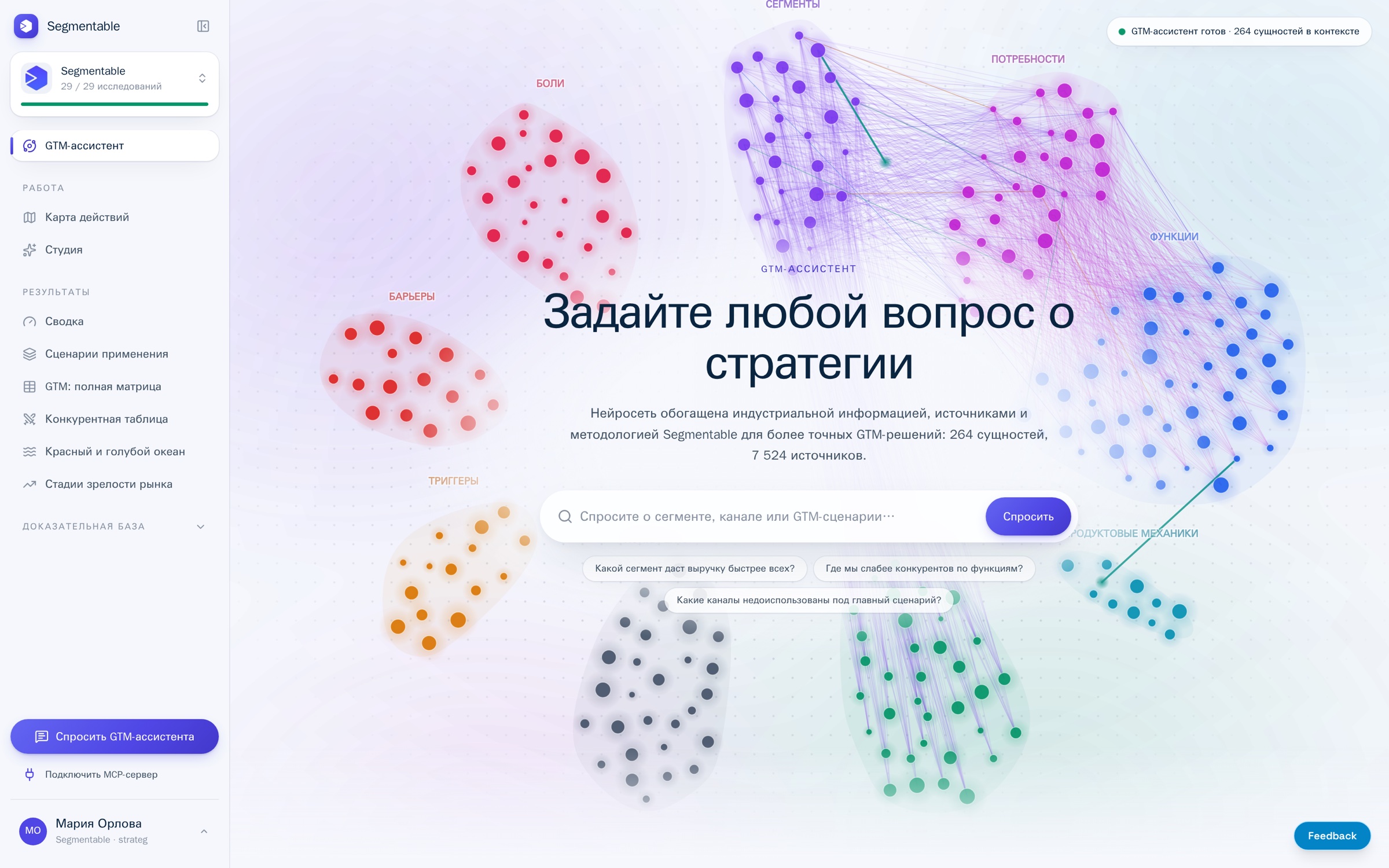
Every screenshot below is one live project: the GTM research of the market Segmentable itself operates in. The system does not end with a report — the data remains a workspace How evidence works →
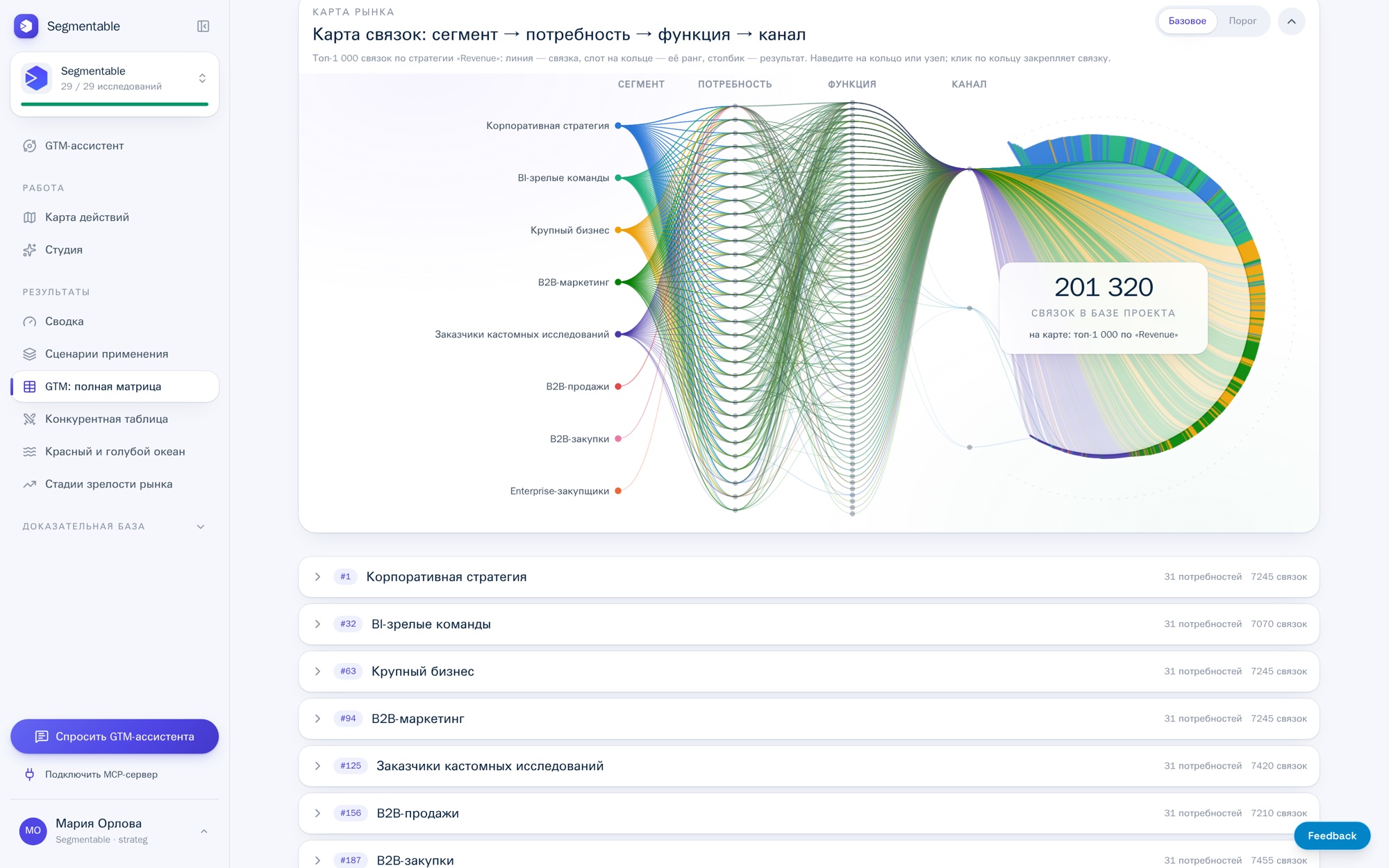
What the market says about the project: research coverage, industry frame, opportunities and risks, with links into every workspace
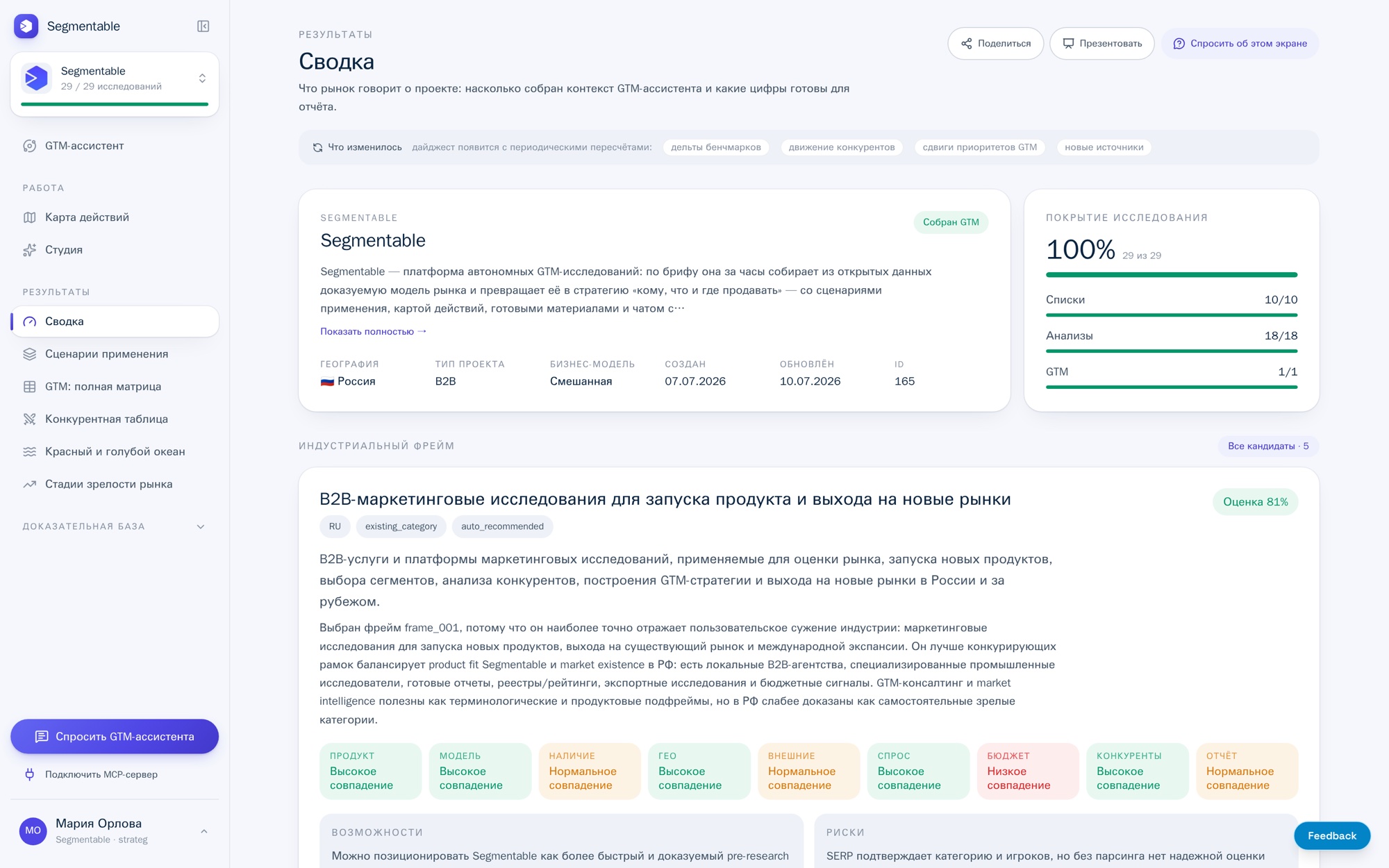
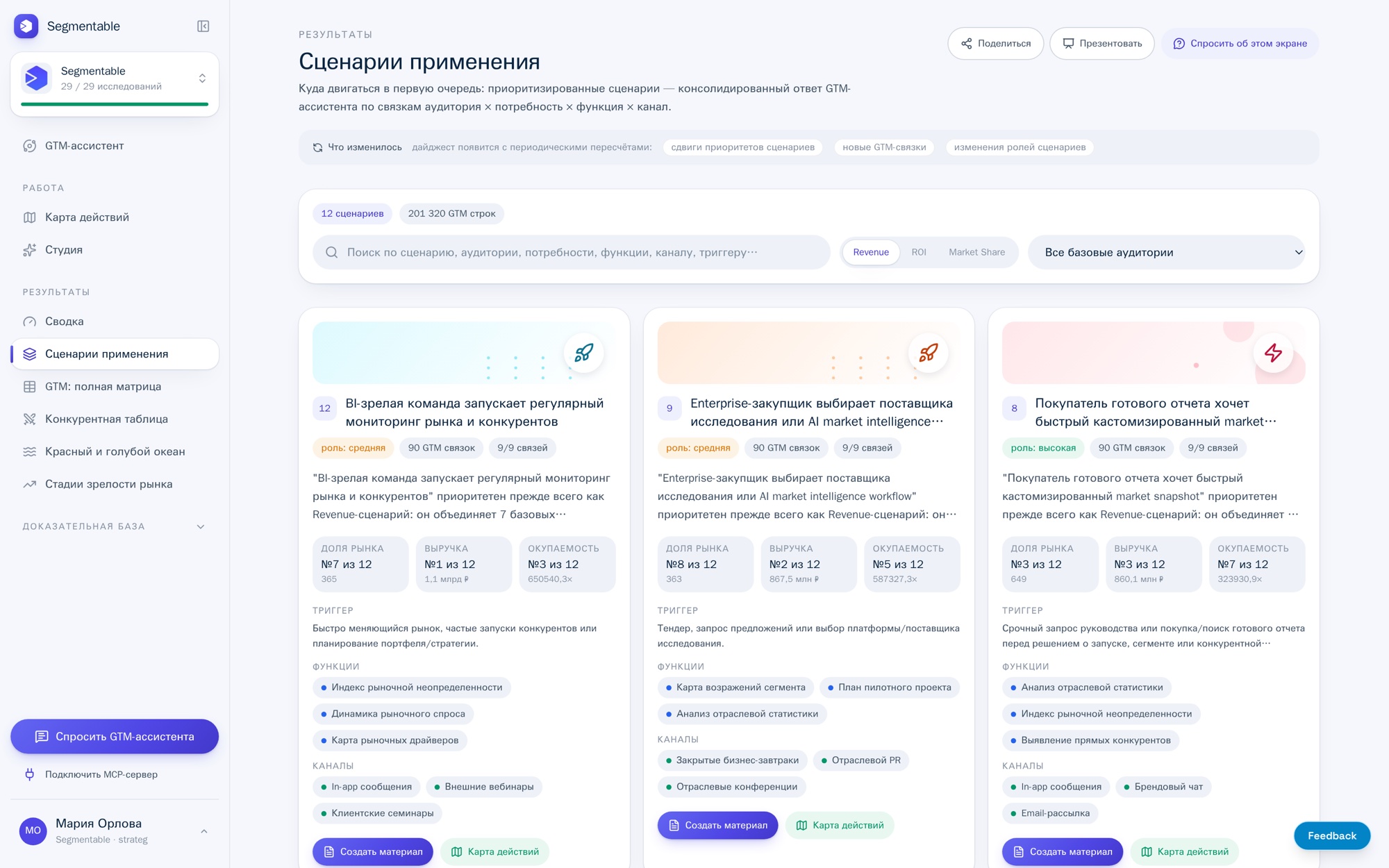
The Segmentable project contains 201,320 such combinations. The system then evaluates each combination against the selected business objective
The system then ranks the combinations and shows which segments, needs, features, and channels offer the best starting point for entering the market
A scenario combines the target segment, need, product features, promotion channels, and estimated potential revenue. From the scenario, you can immediately create a landing page, presentation, or another marketing asset
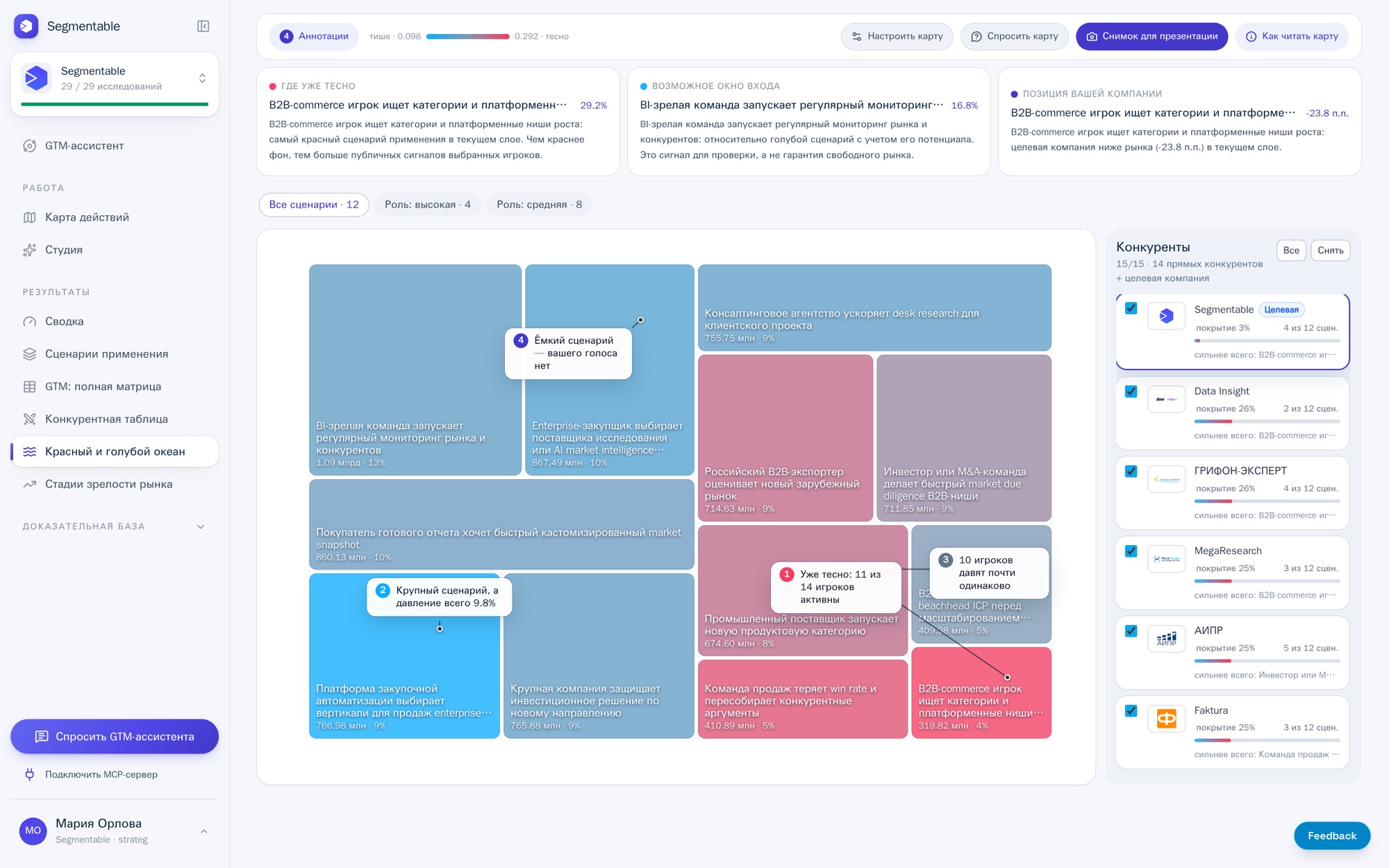
Where competitor signals show market crowding, where blue zones remain, and where your company sits on the map
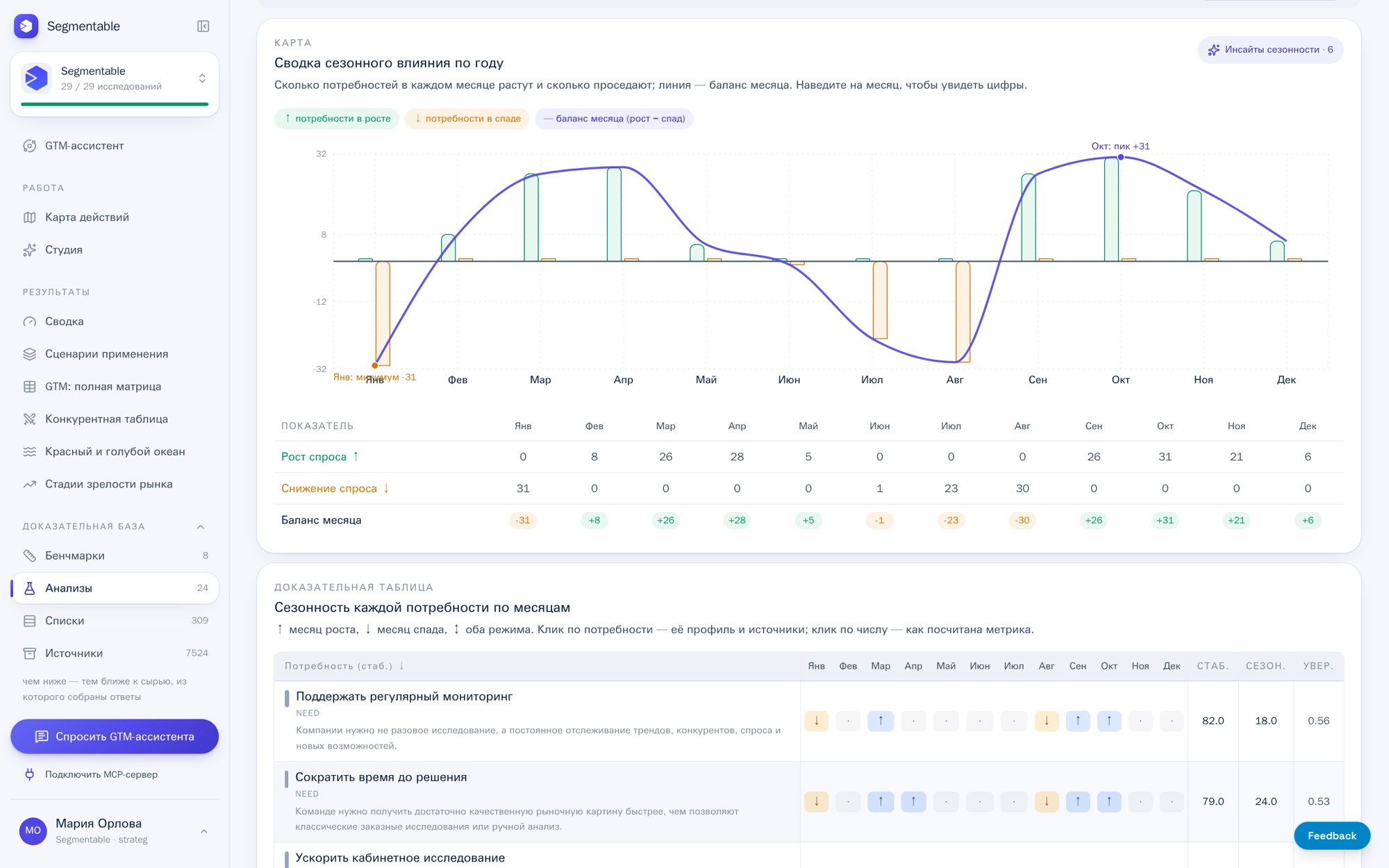
Demand peaks and launch windows, with an evidence table beneath the chart
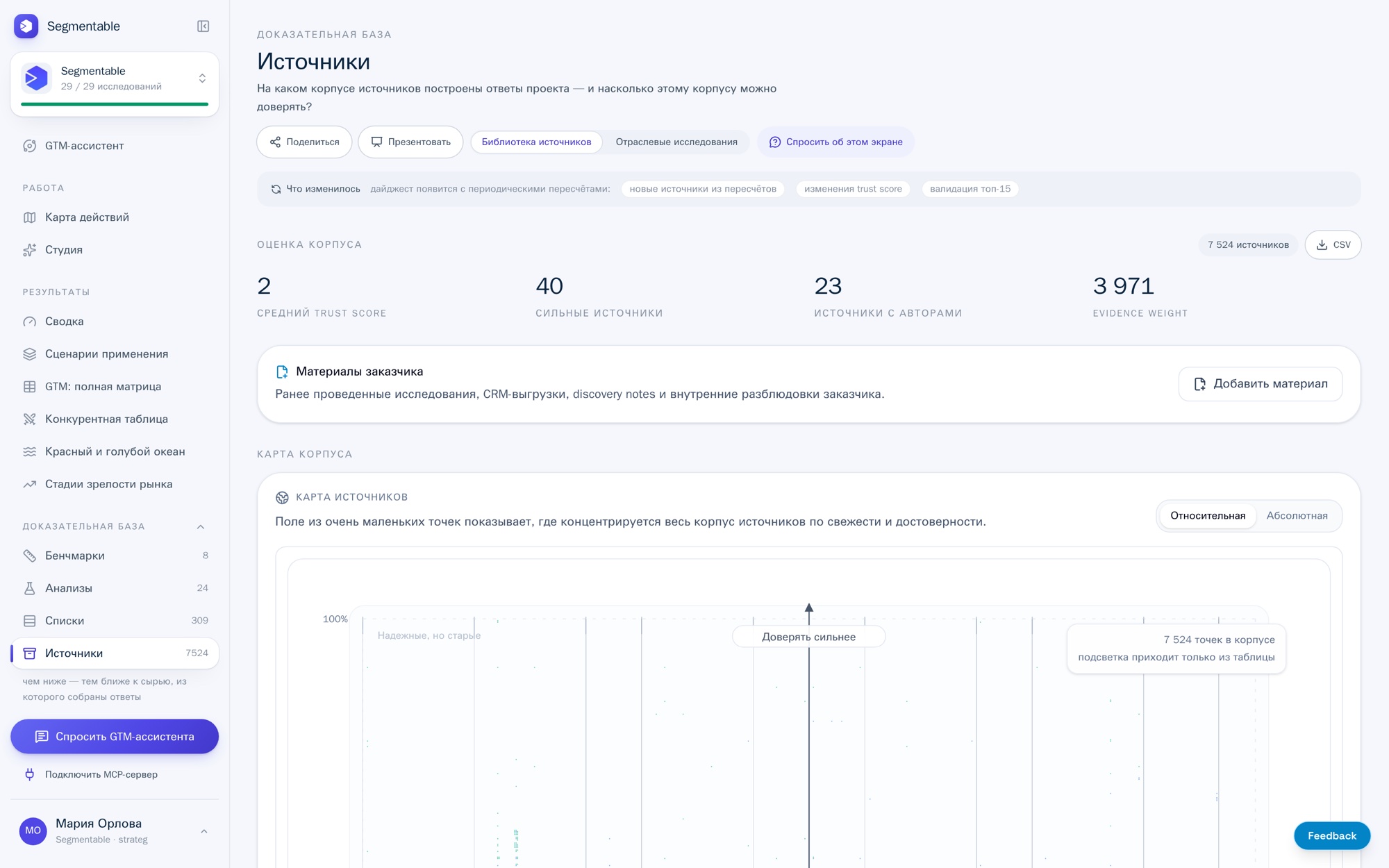
7,500+ sources with trust scores — down to the raw material behind any answer
A scenario workspace: initiatives, channels, and landing-page elements
I was shocked that Segmentable does in 2 minutes what used to take months.
Every result block is tied to sources and moves into action: segment choice, channel setup, message, landing page, presentation
Ranked segmentation: which customer groups can deliver the most revenue with your resources
Pains, triggers, barriers, and selection criteria — what each segment is really buying
How players are positioned, where their gaps are, and which white spaces you can occupy
Where to invest promotion budget, and which channels do not match audience behavior
Whole product for every play: before/after, entry window, funnel initiatives, and a bridge to execution
Landing pages, presentations, and sales kits for each segment and channel, assembled from project data
The higher the cost of error, the deeper you should dig: from a quick direction check to a full market that can withstand board defense
Check a direction: target market, key competitors, and first scenarios in one evening
A working product strategy: competitors, segments, needs, channels, and launch materials
Maximum depth for a critical launch, board review, or a large new direction
Start with one hypothesis in an evening, move to a subscription when research becomes a flow, or build an enterprise setup with integrations and a dedicated strategist
First hypothesis test: no subscription, pay per project
$0 + projects from $6,900A live GTM loop for one product: regular checks and updates
$45,000 / mo.A synchronization environment for marketing, product, and sales
$980,000 / yearCommittees, security review, integrations, and team training
$4.9M / yearNot ready for a full project yet? One-off analyses from $12: and
Companies that allowed us to publish feedback on our work

Retail · Foodtech
A grocery retail and delivery network developing its own store and digital formats

IT · Infrastructure
Developer of a distributed DBMS and infrastructure solutions for high-load enterprise systems

Retail · Technology
A food retail company developing store networks, logistics and digital services

Finance · Data
A credit bureau and provider of data and scoring solutions for the financial market

Beauty · Retail
A perfume and cosmetics retailer with physical and online sales channels
FMCG · Oral care
The international division of R.O.C.S., a manufacturer of oral care products
Fintech · Travel
Card&Go by Sitora, a fintech service for obtaining international bank cards

FMCG · Food
A food brand producing ready-made sauces and products for home cooking
Research is built only on external open data — nothing is taken from your perimeter. Teams and roles, integrations and MCP, a dedicated strategist and training, and transfer of finished projects inside the organization
A platform that, in hours, assembles a model of your market from open data — segments, needs, competitors, channels — and turns it into a go-to-market strategy with ready materials
From open market sources: player websites and materials, reviews, job postings, media, catalogs. Every number clicks through to its source, and assembly coverage is visible on the proof page
A chat answers with a retelling and no sources. Segmentable builds a verifiable model: methodology, segment and need matrices, a competitive map, and click-to-source behind every number
By an order of magnitude in time and price: hours instead of months, a fraction of an agency GTM engagement. The result is not slides but a living market model you can refresh
A one-off Explore study starts at $79, quick products at $12. A subscription is only needed once research becomes regular
The model is built from external open market data — nothing is required from your internal loop except the website and a short brief
Describe the product or just provide a website link — the system will assemble segments, competitors, needs, channels, and first promotion materials
Leave a request — we will discuss your task and suggest a research format