Skip to content

By Grigory Bocharov

The Segmentable methodology

How to turn tens of thousands of open-market signals into an evidence-based go-to-market strategy — from the research framework to a ready marketing funnel

Go-to-market strategy

A detailed walkthrough of how to bring a product to market using our methodology

Before AI, building a strategy on real-world data was accessible only to large companies

Companies commissioned expensive research projects that took months to complete

By the time the strategy was presented, some of the data was already outdated

As a result, strategies were often based on

  • a limited number of studies
  • the experience of individual strategists
  • subjective assumptions about the market
  • respondent answers that could contain bias or inaccuracies

The vast body of knowledge already available in open sources remained unused

Grigory Bocharov, founder of Segmentable

What has changed today

Grigory BocharovFounder of Segmentable

Today, around forty thousand product professionals in Russia and roughly four million worldwide are trying to answer the same questions: who the product is for, what those people need, which product capabilities address those needs and which channels should carry the communication

At Segmentable we help teams answer these questions using market data, rather than intuition

The primary goal is to reduce time-to-market and improve the efficiency of marketing investment

Why is speed to market critical?

Speed to market is now one of the key sources of competitive advantage

But speed alone is not enough

You need to understand

  • which segment to enter
  • which needs to address
  • which capabilities to develop
  • where to build communication

Every hypothesis requires investment, which makes the ROI of marketing activities

The Segmentable methodology enables teams to

  • analyse the market using tens of thousands of sources
  • use more than 100 types of marketing analysis
  • forecast the ROI of different go-to-market scenarios

Speed to market is one of the key factors that separates winners from losers today

How the Segmentable methodology works

The Segmentable methodology is a structured research and analytics system for identifying the most effective data-backed go-to-market strategy

A visual metaphor for taking a product into a new market quickly
Each stage solves a specific problem, from structuring the market to selecting a particular go-to-market strategy
  1. 01Profile
  2. 02Data
  3. 03Segments
  4. 04Needs
  5. 05Capabilities
  6. 06Competitors
  7. 07Analytics
  8. 08Maturity
  9. 09Strategy
  10. 10Funnel

Research framework

Project profiling

We define the market geography, research language, industry context and a detailed product description

  • if a product enters several countries, we research each market separately
  • we account for the local structure of segments, needs and channels
  • we align on known hypotheses and competitors
Stage outcome

A clear framework in which data can be compared and verified

Research

Market data collection

The system collects a large body of open data about the market, product, competitors and audience behaviour

  • user reviews and discussions
  • marketing materials, product reviews and company websites
  • industry studies, professional communities and regulatory documents
Stage outcome

A comprehensive set of market signals backed by verifiable sources

Market structure

Selecting segmentation types

After the initial analysis, we select the segmentation types that are genuinely relevant to the project

  • segments may overlap across different dimensions
  • we propose segmentation models that fit the market
  • the client can add internal segments and hypotheses
Stage outcome

A practical segment map rather than one averaged customer portrait

Priorities

Ranking customer needs

We assess the importance of each need separately for every segment

  • frequency of the need across sources
  • source reliability and quality of the problem description
  • product usage context
Stage outcome

A ranked list of the jobs that matter most to each segment

Product

Capability analysis using the Kano model

We classify product capabilities by how they affect customer value

  • Must-have — the minimum required value
  • Performance — capabilities that increase satisfaction
  • Attractive — unexpected differentiating capabilities
Stage outcome

Clarity on what the market requires and what creates competitive advantage

Competition

Deep competitive analysis

We compare not only companies but also their segments, capabilities, needs and marketing offers

  • which capabilities each player provides
  • which segments and needs each player addresses
  • which messages and channels each player uses
Stage outcome

The real competitive structure and underserved areas of the market

Analytics

Analytics engine

We collect benchmarks for key parameters and refine value ranges through a series of calculations

  • segment size, average order value and usage frequency
  • product penetration and channel efficiency
  • value ranges for key market parameters
Stage outcome

More than 100 analysis types turn raw signals into comparable metrics

Market maturity

Assessing market maturity

We use Everett Rogers’ diffusion of innovations model to assess the market’s readiness for a product

The classic model distinguishes the following groups: innovators, early adopters, early majority, late majority and laggards

This matters for go-to-market strategy because each stage perceives product value, makes decisions and responds to communication differently

The go-to-market strategy depends directly on market maturity

In early-stage markets the most effective approach is usually to focus on selected segments and build communication around their specific needs

In more mature markets, the strategy changes. When a market is crowded and the product’s basic value is already understood, broader coverage is more effective than a single narrow segment, with the offer, capabilities and communication adapted for different customer groups

  • innovators, early adopters and the early majority
  • late majority and laggards
  • different stages require different approaches to value, offers and communication
Stage outcome

Clarity on the market coverage and communication logic appropriate to its current stage

Strategy

Calculating positioning options

We build go-to-market combinations from a segment, need, product capability and communication channel

  • hundreds of thousands of potential combinations
  • mathematical assessment of impact on market share, ROI and revenue
  • ranking combinations by expected business impact
Stage outcome

A list of the most promising go-to-market strategies

Execution

Funnel and marketing materials

We translate the selected strategy into a five-stage funnel and concrete launch materials

  • Awareness, Interest, Education, Decision and Conversion
  • landing pages, video, audio, advertising creative and presentations
  • sales pitches and communication scenarios for the selected channels
Stage outcome

A ready go-to-market system in which tactics are tied to an evidence-based strategy

Why the optimal combination cannot be selected manually

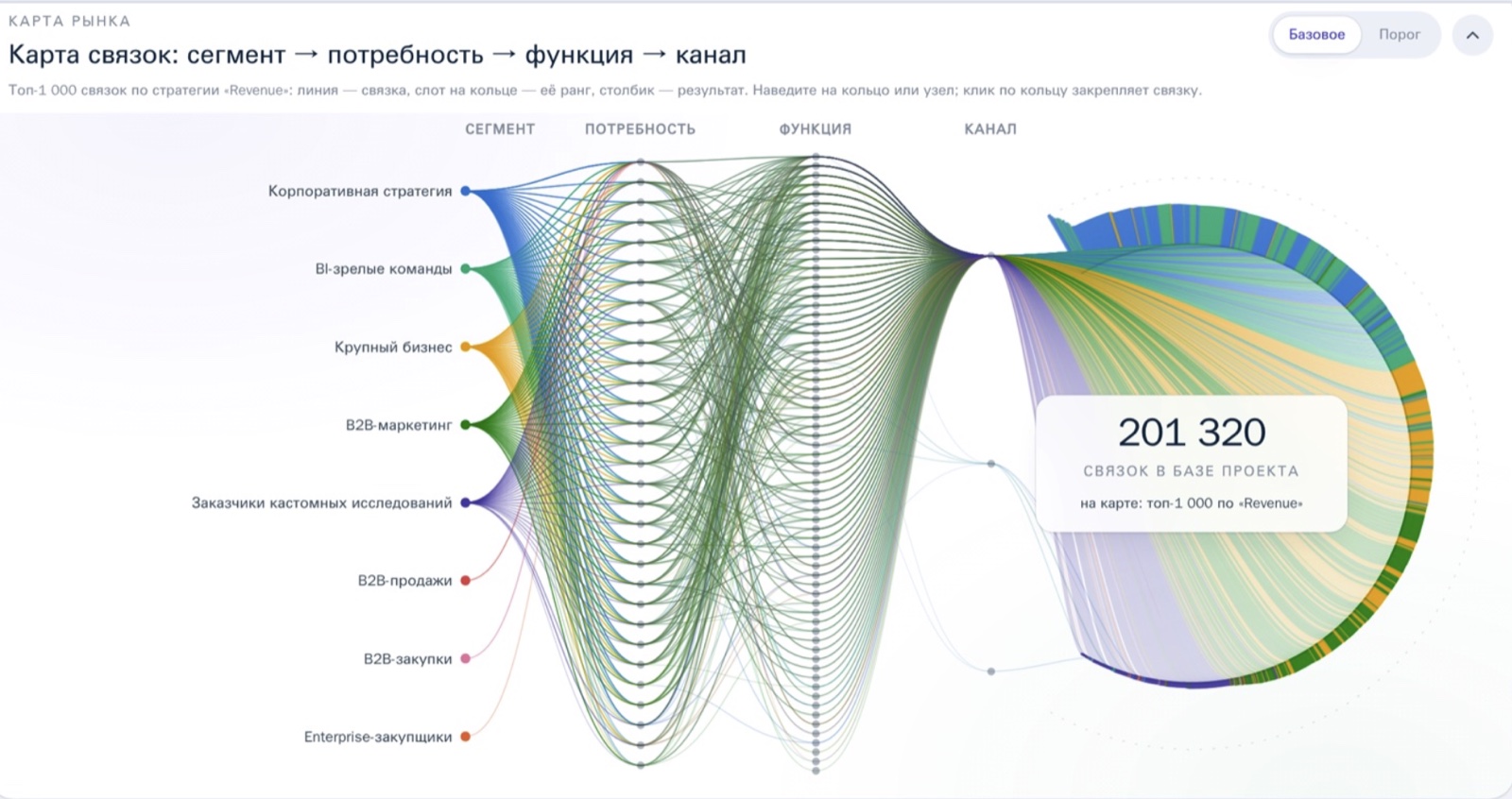
A typical study contains at least 30 segments, around 40 needs, more than 100 capabilities and roughly 40 channels. Multiplying them produces hundreds of thousands of positioning options

A model developed with research teams in Akademgorodok calculates the impact of every combination on key business parameters and produces a ranked list of strategies

A map of combinations between segments, needs, capabilities and channels
201,320 possible combinations in a single project

Not a report, but a ready go-to-market system

The company receives an evidence-based strategy and tactical launch tools: landing pages, creative, presentations, sales pitches and communication scenarios for the selected channels

structured market analysis
competitive map and white spaces
mathematically prioritised strategies
marketing funnel and launch materials

Test the methodology in your market

Describe your product and the system will prepare the framework for your first study

Start for free