
Four fields with evidence
Each cell derived from collected data, with click-through to the material behind it.
A classic SWOT is a team’s opinion about itself. Segmentable assembles one from outside data: what the market says about you and your competitors, where the real threats sit and which opportunities nobody has taken. Every cell clicks through to its source.
Brief in 10 minutes · assembly in ~2 hours · every number clicks through to its source
A SWOT analysis lays a company’s position out across four fields — strengths, weaknesses, opportunities and threats. It is the most widely used strategy frame in the world, and also the most widely abused one, because almost nobody feeds it anything but the room’s own opinions.
The failure mode is easy to recognise. Strengths list what the team is proud of, weaknesses list what it already planned to fix, opportunities restate the current roadmap, and threats name the one competitor everybody mentions. Nothing in the exercise can surprise anyone, so nothing in it changes a decision.
Segmentable builds the same four fields from collected market data. Strengths and weaknesses come from how your materials and reviews compare with competitors’; opportunities come from needs the category leaves unserved; threats come from player movement and market forecasts. The frame stays familiar — what changes is that each cell carries evidence.
Each cell derived from collected data, with click-through to the material behind it.
Not what you like about yourself, but what you actually hold against named competitors.
What customers complain about in your category, including where it applies to you.
Unserved needs and channels with capacity left — with an estimate of what they are worth.
Player entries, positioning shifts and demand trends rather than a generic risk list.
The SWOT feeds the go-to-market scenarios instead of ending as a standalone slide.
Your site is enough — the system identifies the category and the players itself.
Competitor materials, reviews, sources and market signals become the input for all four fields.
Every cell opens into the data behind it, so “where is that from?” has an answer.
Real product screens, not mockups.
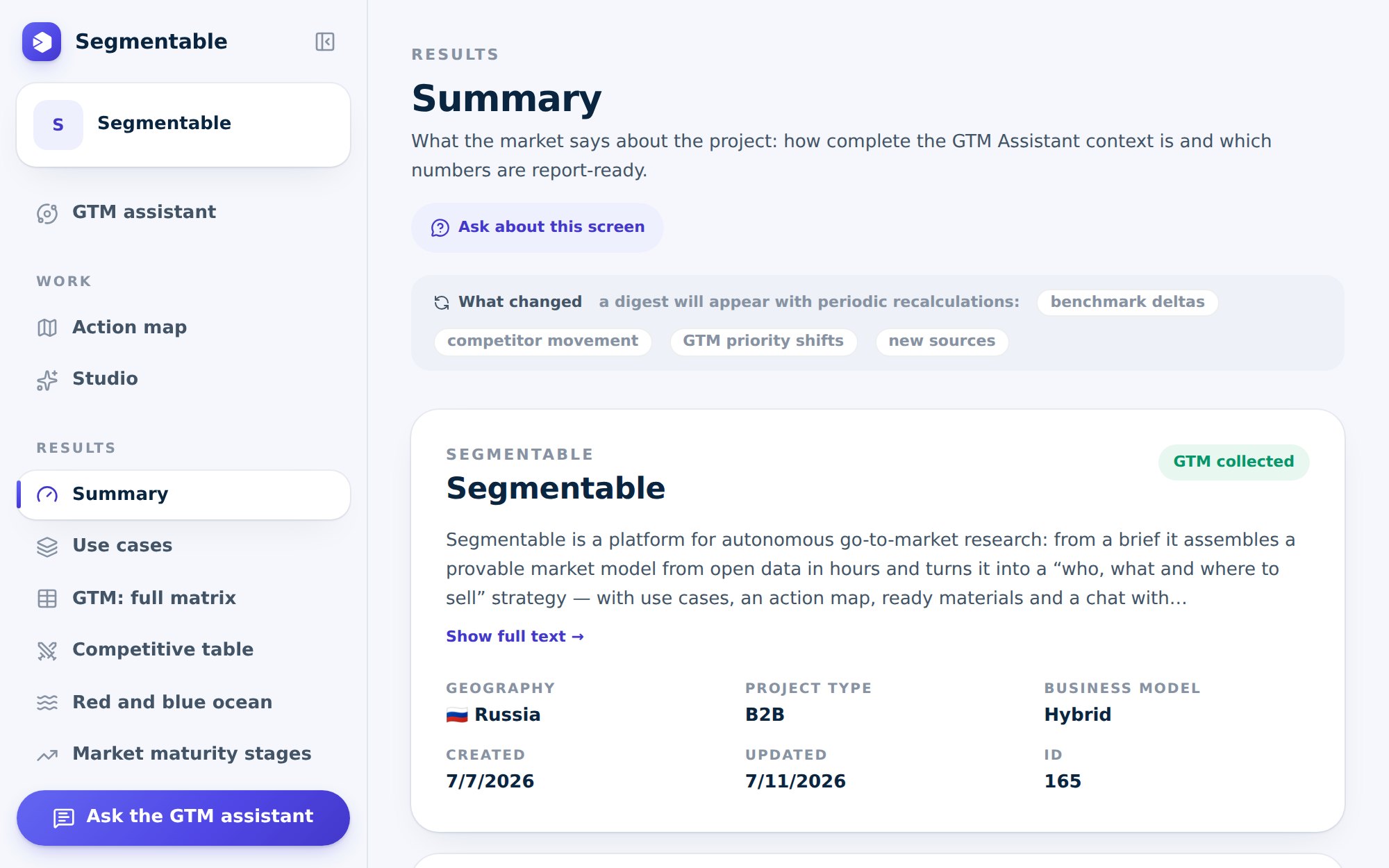
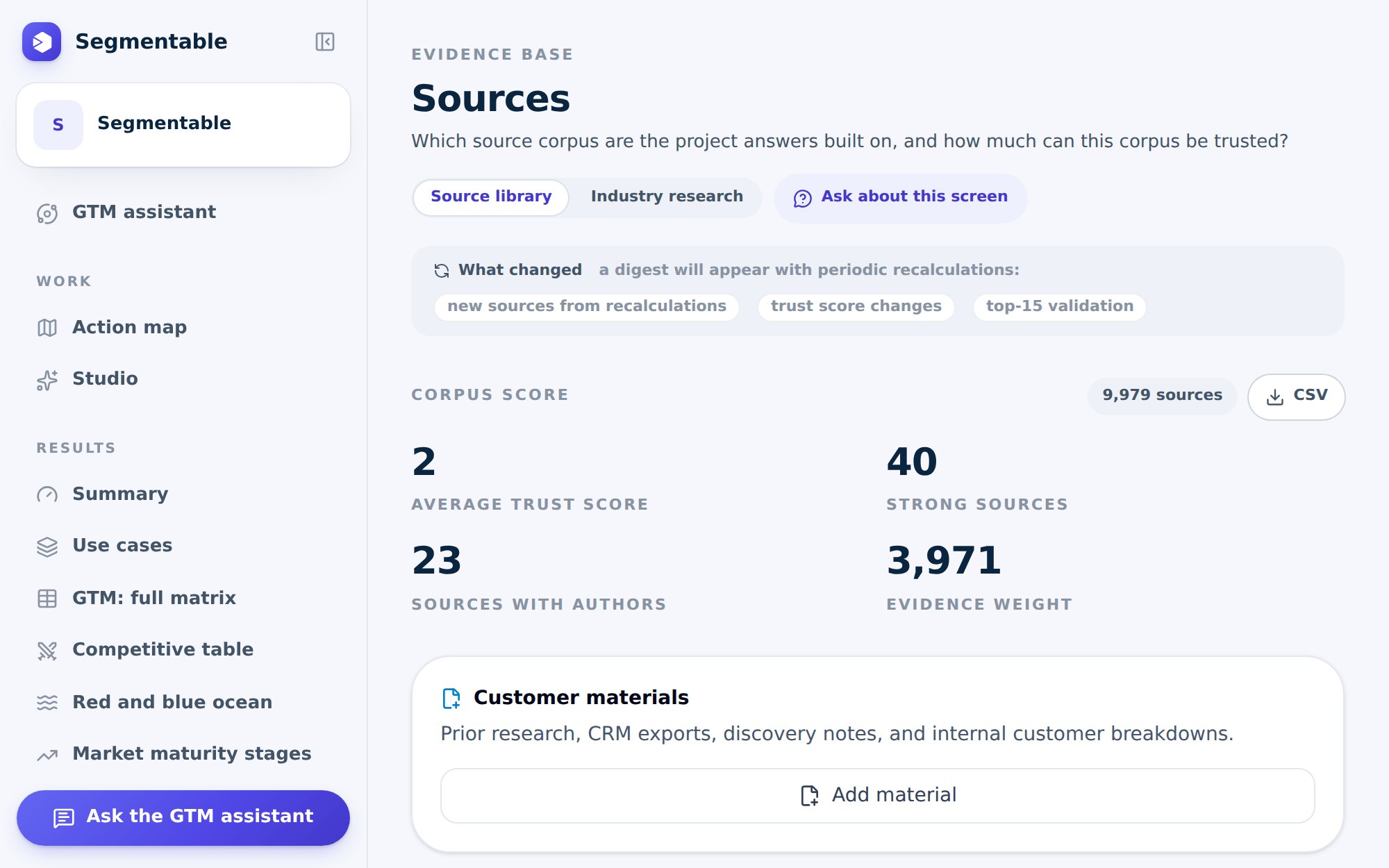
You need a reasoned answer by a date, and “I think” will not carry the room.
A similar situation →The frame has to hold up when someone asks where a threat estimate came from.
A similar situation →A committee will check the reasoning, so the analysis has to be checkable.
A similar situation →| Segmentable | By hand | Agency | ChatGPT | |
|---|---|---|---|---|
| Input | Collected market data | The room’s opinions | Desk research plus interviews | Model memory |
| Time | ~2 hours | A workshop | 2-4 weeks | Minutes |
| Verifiability | Source behind every cell | None | Partial | None |
| Feeds strategy | Yes, wired into scenarios | Usually not | Sometimes | No |
A SWOT built from data comes as part of the market model: segments, competitors, needs and the evidence base behind them.
from $79 · we set it up with you
An actual analysis. A template hands you four empty boxes; here the boxes arrive filled from collected market data, and you can open the evidence behind each statement.
Competitor materials and positioning, customer reviews, industry sources, demand signals and market forecasts. The exact source list is visible in the report.
A short one, and it becomes useful: instead of generating the content, the team argues with evidence and decides what to do about it.
A chat produces a plausible-sounding SWOT for any company in seconds and cannot show you where a single line came from. The difference is not speed, it is whether the result survives the question “where is that from?”.
A one-off Explore run starts at $79 and includes the SWOT along with segments, competitors and channels. Dollar checkout is not open yet, so we set the first run up with you directly.
Yes. The project stays live, so a re-run shows which threats and opportunities actually moved instead of producing a new document from scratch.
Describe your product or just give us a link to your site — the system will collect the data and answer the question behind your task.