Demand signals
Evidence that the problem exists and at what scale — from reviews, searches and community discussion.
Before writing code or committing budget, check the idea against the market that already exists: who has the problem, who already solves it, what they charge, and what would have to be true for this to work. Answer in a day, with sources.
Brief in 10 minutes · assembly in ~2 hours · every number clicks through to its source
Validating a business idea means answering three questions before spending real money: does anyone actually have this problem, is somebody already solving it, and can you reach the people who do. Most validation skips straight past all three and goes to “let us build a landing page and see”.
Talking to a few potential customers is the usual advice, and it is good advice — but it answers only the first question, slowly, and with a sample small enough that one enthusiastic conversation can carry a whole quarter. It tells you nothing about who already occupies the space or what they charge.
Segmentable answers all three from the market that already exists. It finds who has the problem and in what volume, who serves them today and how, what the going price is, and where demand is heading. The result is not a verdict handed down by a model — it is a structured picture with the evidence attached, so you can decide and defend the decision.
Evidence that the problem exists and at what scale — from reviews, searches and community discussion.
The players occupying the space today, how they position and what they charge.
Which groups have the problem sharply enough to pay, and which merely have it.
What would have to be true for this to work, and where the assumption is weakest.
TAM, SAM and SOM derived from segment structure rather than from a headline figure.
Take it or drop it, with the reasoning and the sources behind the recommendation.
No framework, no template — a few sentences about what you want to build and for whom.
Demand, existing players, pricing and trends are collected and structured.
A verdict, the reasoning and click-through to the source behind every claim.
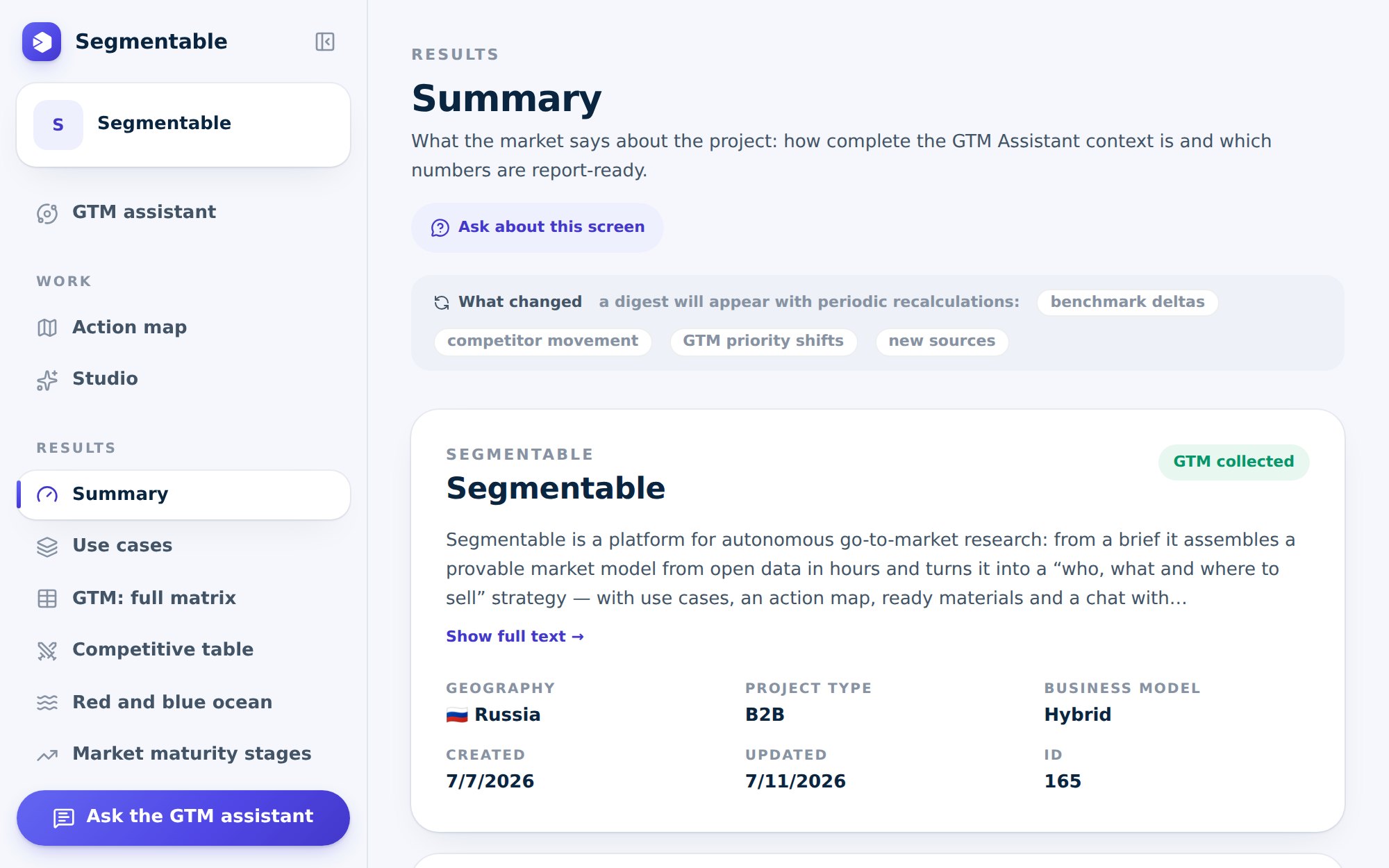
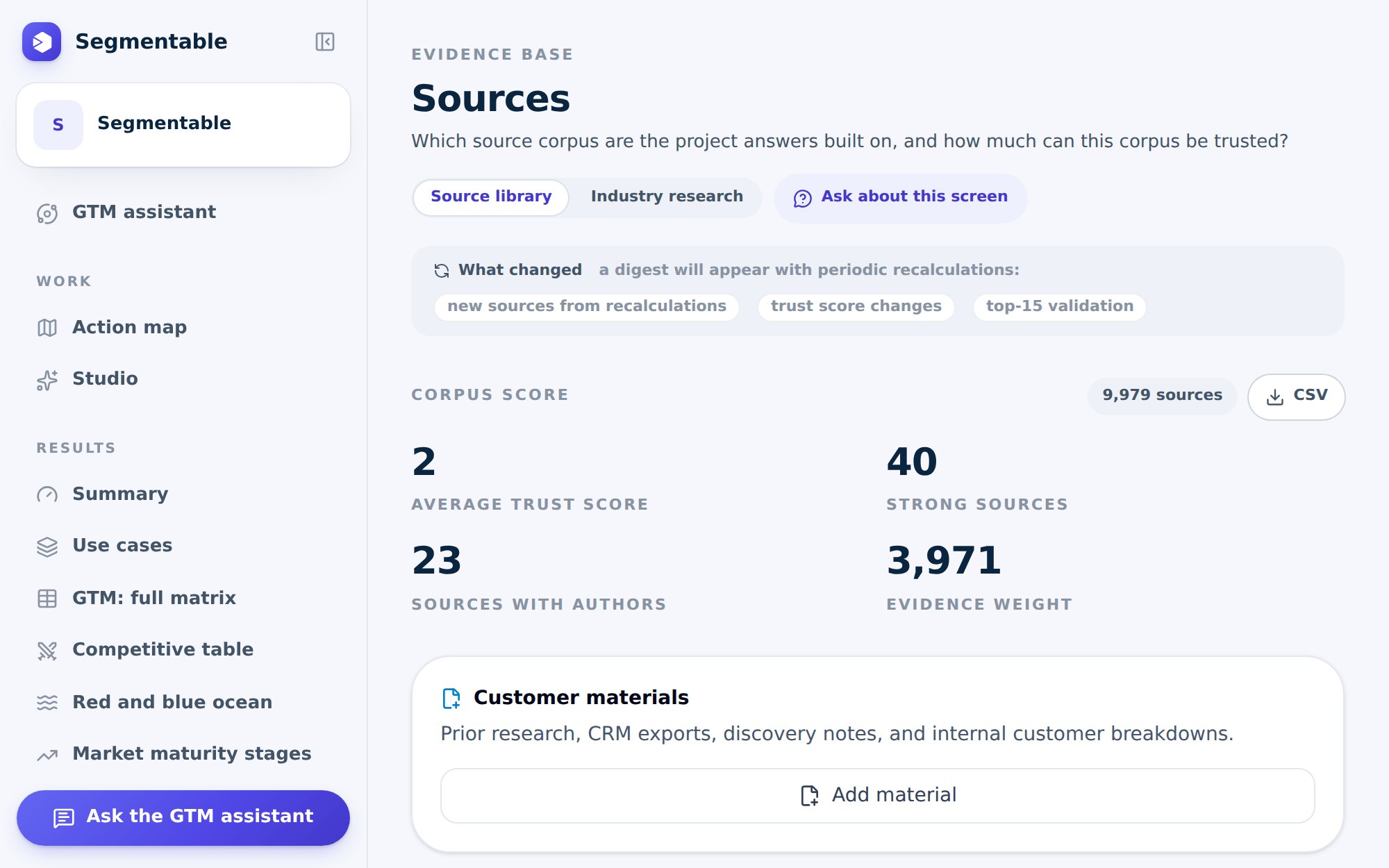
Real product screens, not mockups.
You have to take it on or turn it down with reasons, by a date that is already close.
A similar situation →The cheapest version of this check is the one that happens before the first sprint.
A similar situation →More ideas than hands, and nothing to compare them with fairly.
A similar situation →| Segmentable | By hand | Agency | ChatGPT | |
|---|---|---|---|---|
| Time | A day | A week of asking around | 3-6 weeks | Minutes |
| What it checks | Demand, players, pricing, risks | Mostly demand | All of it, slowly | Whatever the prompt asked |
| Verifiability | Source behind every claim | Anecdotes | Cited selectively | None |
| Comparable across ideas | Same method every time | Depends who asked | Too expensive to repeat | Depends on the prompt |
The idea check comes as a market model: demand, segments, existing players, pricing and the evidence behind the verdict.
from $79 · we set it up with you
It can rule one out cheaply and tell you what would have to be true for it to work. It cannot promise success — nothing can. What it removes is the class of failure where the answer was already public and nobody looked.
No, it sequences them. The check tells you which segments are worth talking to and what to ask, so interviews stop being a fishing expedition.
That is the cheapest outcome available. An unwelcome answer with sources costs less than two quarters spent building toward it — and the report says which assumption failed, not just that it did.
A chat will validate almost any idea if you phrase it hopefully, and it cannot show you a single source. Here the answer comes from collected market material and every claim opens into the evidence.
A one-off Explore run starts at $79 and covers demand, segments, competitors and market size. Dollar checkout is not open yet, so we set the first run up with you directly.
Yes — that is the usual pattern for teams with a queue. Each idea goes through the same method, so the results are comparable instead of depending on who prepared them.
Describe your product or just give us a link to your site — the system will collect the data and answer the question behind your task.