Segments with real boundaries
Groups derived from market behaviour, not from a whiteboard split by company size.
Most personas are invented in a workshop: a name, a stock photo, a guess about goals. Segmentable builds them from what the market actually says — reviews, job posts, forums, competitor materials — so each persona carries evidence you can check.
Brief in 10 minutes · assembly in ~2 hours · every number clicks through to its source
A buyer persona is a compact profile of one type of customer: what job they are trying to do, what stops them, what they compare you against, and what language convinces them. Done well, it makes marketing and sales say the same thing. Done as a workshop exercise, it becomes a slide nobody opens twice.
The reason invented personas fail is simple: they encode what the team already believes. If everyone in the room thinks the buyer is price-sensitive, the persona says price-sensitive, and the whole funnel gets built on that assumption. Nothing in the process can contradict it, because no outside data entered the room.
Segmentable builds personas the other way round. It collects what your market publicly says — customer reviews, job postings, community threads, competitor positioning — and derives the segments from that material. Each persona arrives with pains, objections and tone of voice, and every claim behind it opens into the source it came from.
Groups derived from market behaviour, not from a whiteboard split by company size.
What each segment is actually trying to solve, in the words they use themselves.
What makes each persona hesitate, so sales meets the objection prepared instead of surprised.
How this audience talks about the problem — the vocabulary that makes copy land.
Where each group already looks for a solution, so budget stops spreading evenly across everything.
Each persona attribute clicks through to the review, post or page it was derived from.
Your site is enough to start — the system works out the category and the players itself.
Reviews, job posts, communities, competitor materials — public traces of how this market behaves.
Segments, pains, objections and tone of voice, each with click-through to its source.
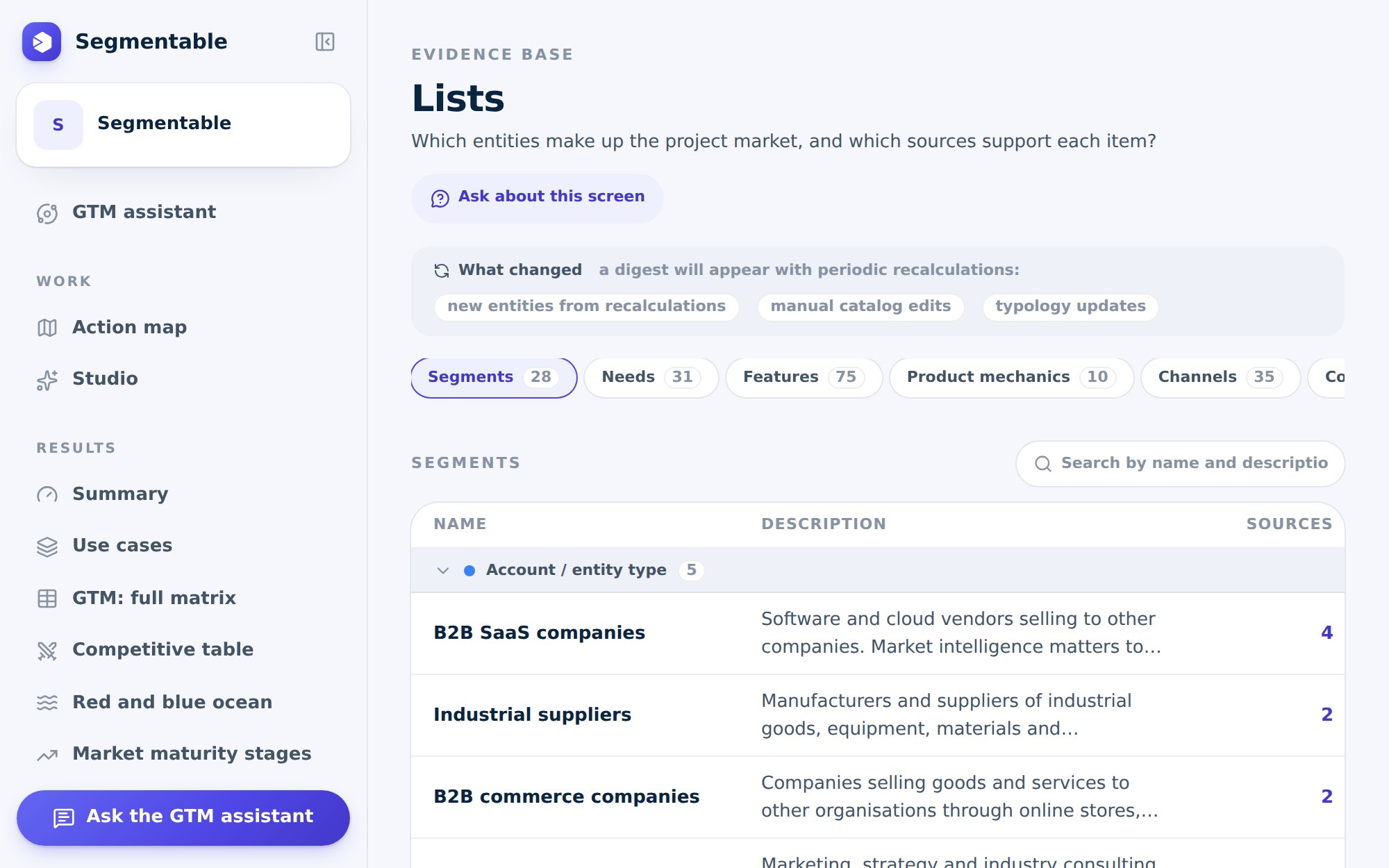
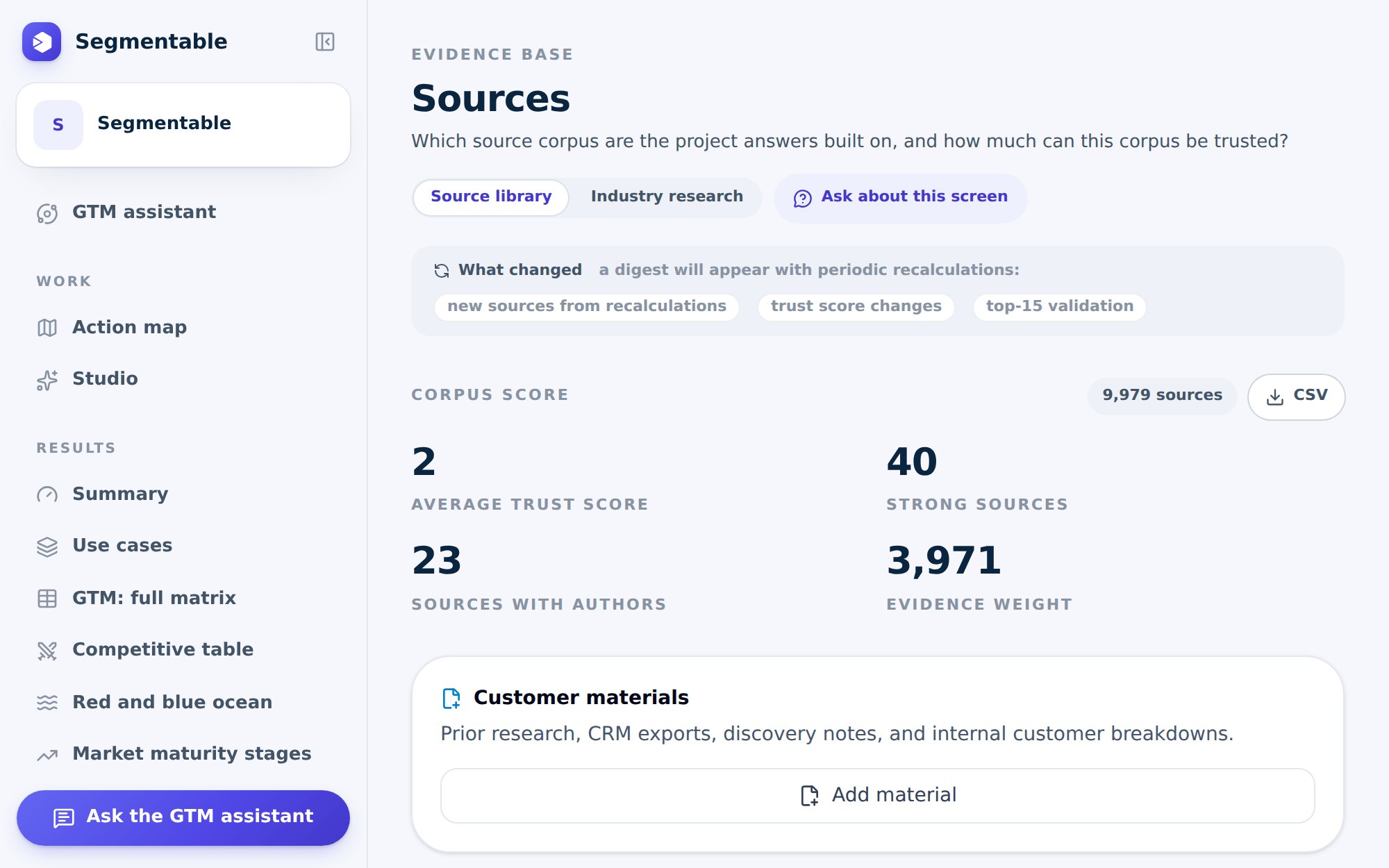
Real product screens, not mockups.
The product is built and now it has to sell — you need to know who needs it most and why.
A similar situation →The board expects a plan, and “our buyer is roughly like this” will not survive the first question.
A similar situation →Each team has its own picture of the buyer, and the pictures do not agree.
A similar situation →| Segmentable | By hand | Agency | ChatGPT | |
|---|---|---|---|---|
| Where it comes from | Public market data | The team’s assumptions | Interviews plus desk research | Model memory |
| Time | ~2 hours | A workshop plus rewrites | 3-6 weeks | Minutes |
| Verifiability | Source behind every attribute | None | Cited selectively | None |
| Comparable across products | Same method every time | Depends who ran the session | Depends on the engagement | Depends on the prompt |
Segments of your target audience with pains, needs, demographics and tone of voice — from real market data, in 30-60 minutes.
from $12 · we set it up with you
A template gives you empty boxes and you fill them with what you already assume. Here the boxes arrive filled from market material, and you can open the source behind each one and disagree with evidence.
No. Personas are derived from external public data about the market. If you do have internal research, it can be added on the higher plans, but nothing is required to start.
As many as the market actually supports — usually three to six meaningful segments. The system does not pad the list to hit a round number.
That is the common case here. For B2B the persona is a role inside a buying group, and the material comes from job posts, vendor comparisons, industry communities and procurement language.
The persona product starts at $12. A full market model with segments, competitors and channels starts at $79. Dollar checkout is not open yet, so we set the first run up with you directly.
Yes. The project stays live, and a re-run shows which pains and objections shifted rather than producing a fresh document from zero.
Describe your product or just give us a link to your site — the system will collect the data and answer the question behind your task.